
Transform Your Business with Lean Principles & Proven Techniques
Is your organization ready to eliminate waste, improve efficiency, and boost profitability?
We help businesses unlock their full potential using the powerful tools and techniques of Lean Thinking — driving sustainable growth and operational excellence across all levels.
“Let’s understand what Lean principles are.”
Lean principles are fundamental guidelines that focus on maximizing customer value while minimizing waste. They enable organizations to deliver improved quality, faster service, and reduced costs through systematic process improvement.
Core Lean Principles
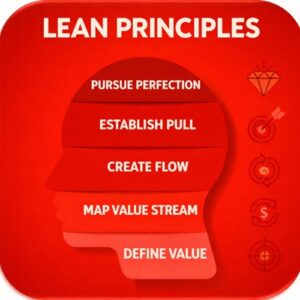
Define Value – Understand what the customer truly needs and is willing to pay for.
Map the Value Stream – Identify all steps in the process and remove waste.
Create Flow – Ensure work moves smoothly without delays or bottlenecks.
Establish Pull – Produce only what is needed, when it is needed.
Pursue Perfection – Continuously improve processes to achieve operational excellence.
Why Lean Principles Matter
Lean principles help organizations:
Reduce cycle time and costs
Improve quality and consistency
Increase customer satisfaction
Build a culture of continuous improvement
This makes Lean applicable across manufacturing, services, healthcare, IT, BPOs, and call centers, not just factories.
Lean Waste Identification Tools (Muda)
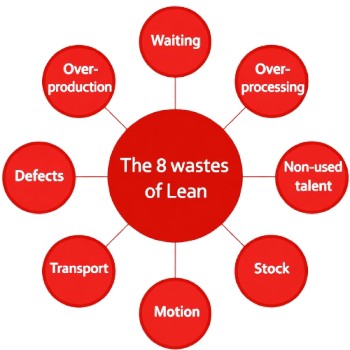
8 Wastes (TIMWOODS)
The 8 Wastes represent activities that consume time, cost, or effort without adding customer value. Identifying and eliminating these wastes helps organizations improve speed, quality, and efficiency.
Transportation: Unnecessary movement of information, materials, or work
Inventory: Excess work-in-progress or pending tasks
Motion: Extra effort or movement by people
Waiting: Idle time due to delays or dependencies
Overproduction: Doing work earlier or more than required
Overprocessing: More work or approvals than needed
Defects: Errors, rework, or corrections
Skills (Underutilized Talent): Underutilization of employee talent and ideas
Lean Core Tools (Most Used)
Practical Methods to Improve Process Flow, Quality, and Efficiency
Value Stream Mapping (VSM) – A visual method to map end-to-end process flow and identify waste, delays, and improvement opportunities.
5S (Sort, Set in Order, Shine, Standardize, Sustain) – A workplace organization method to improve efficiency, visibility, and discipline.
Kaizen (Continuous Improvement) – A structured approach to make small, ongoing improvements driven by employees at all levels.
Kanban – A visual workflow system that controls work based on actual demand and limits overproduction.
Standard Work – The best-known way to perform a task consistently, safely, and efficiently.
Visual Management – Use of visual signals and dashboards to quickly understand process status and performance.
Takt Time – The pace at which work must be completed to meet customer demand.
- Workload Balancing (Heijunka) – A method to level work and demand to reduce overload, unevenness, and inefficiencies.
Lean Flow & Production Tools
Tools That Enable Smooth, Fast, and Defect-Free Process Flow
One-Piece Flow – Processing work one unit at a time to reduce waiting, inventory, and defects.
Just-In-Time (JIT) – Producing only what is needed, when it is needed, in the required quantity.
Jidoka (Autonomation) – Building quality into the process by automatically stopping work when an abnormality occurs.
Poka-Yoke (Error Proofing) – Designing processes or systems to prevent errors before they happen.
Cellular Layout – Arranging people and equipment to support smooth flow with minimal movement and handoffs.
SMED (Single-Minute Exchange of Dies) – Reducing setup or changeover time to improve flexibility and responsiveness.
Line Balancing – Distributing work evenly across resources to eliminate bottlenecks and idle time.
Lean Problem-Solving Tools
Structured Tools to Identify, Analyze, and Eliminate Root Causes
Lean Problem-Solving Tools provide a systematic approach to identify problems, find true root causes, and implement sustainable solutions instead of temporary fixes.
A3 Problem Solving – A structured, one-page method to analyze problems, identify root causes, and define corrective actions.
5 Whys – A simple questioning technique to drill down to the true cause of a problem.
Root Cause Analysis (RCA) – A systematic process to identify the underlying reasons behind recurring issues.
Fishbone (Ishikawa) Diagram – A visual tool to categorize and analyze potential causes of a problem.
PDCA Cycle – A continuous improvement cycle to plan, test, implement, and standardize solutions.
Gemba Walk – Observing work at the actual workplace to understand problems and verify facts.
Lean Quality & Stability Tools
Tools That Build Quality into Processes and Ensure Stable Performance
Lean Quality & Stability Tools focus on preventing defects, maintaining process stability, and ensuring consistent output by addressing problems at the source rather than correcting them later.
Andon System – A visual alert system that signals problems immediately so they can be addressed in real time.
Built-in Quality – Designing processes so quality checks are integrated into the workflow, not added at the end.
First Time Right (FTR) – Delivering output correctly the first time, reducing rework and defects.
Total Productive Maintenance (TPM) – A proactive approach to maintain equipment reliability and prevent breakdowns.
Process Confirmation – Verifying that processes are followed as defined to ensure consistent results.
Lean Measurement & Control Tools
Tools to Measure Performance, Control Processes, and Sustain Improvements
Lean Measurement & Control Tools help organizations track performance, identify gaps, and ensure that process improvements are sustained over time through clear visibility and disciplined monitoring.
Key Performance Indicators (KPIs) – Metrics used to measure process performance against defined business objectives.
Process Cycle Efficiency (PCE) – A measure of value-added time versus total process time to identify improvement potential.
Lead Time vs Cycle Time Analysis – Comparing total delivery time with actual work time to expose delays and waste.
Control Boards / Visual Dashboards – Visual displays that show real-time performance and process status at a glance.
Daily Management System (DMS) – A structured routine to review performance, address issues, and drive continuous improvement daily.
Lean Culture & People-Centric Tools
Tools That Build Ownership, Capability, and a Continuous Improvement Culture
Suggestion System – A structured method for employees to share ideas and improvements from daily work.
Employee Empowerment – Enabling teams to identify problems, make decisions, and implement improvements.
Standardized Training (TWI) – A structured approach to train employees consistently and effectively.
Respect for People – Creating a culture that values people, listens to their ideas, and supports problem solving.
Leader Standard Work – Defined routines for leaders to reinforce Lean behaviors and process discipline daily.
Lean Training & Consulting
Practical Learning. Real Projects. Measurable Results.
Acadacy Learning is a training and consulting organization that helps individuals and organizations understand, apply, and sustain Lean practices through practical workshops, real projects, and professional validation.
Our focus is not just learning Lean concepts—but applying Lean to solve real business problems.
Lean Training Workshops
Our Lean training workshops are designed to build strong foundational understanding and hands-on capability in Lean tools and principles.
What Our Lean Training Covers:
Lean principles and mindset
Waste identification (8 Wastes – TIMWOODS)
Core Lean tools and techniques
Practical examples from service and operations
Interactive exercises and discussions
Training Approach:
Instructor-led workshops
Practical and industry-relevant content
Focus on real workplace application
Lean Projects (Hands-On Application)
We strongly believe Lean learning is complete only when applied to real processes.
Acadacy Learning guides participants to execute Lean improvement projects within their actual work environment.
Lean Project Focus Areas:
Process cycle time reduction
Waste elimination
Quality and consistency improvement
Productivity enhancement
Process simplification
Each project follows a structured Lean approach to ensure clarity, logic, and measurable improvement
Lean Project Validation
Acadacy Learning provides independent evaluation and validation of Lean projects completed by oranization, individuals or internal teams.
Project Validation Includes:
Review of Lean tool application
Problem definition and analysis
Improvement implementation assessment
Before-and-after performance impact
Sustainability and standardization review
This ensures Lean projects deliver real and verifiable business value.
Lean Certification (Individual Level)
Participants who successfully complete and validate Lean projects receive a professional Lean Project Validation / Practitioner Certificate issued by Acadacy Learning.
Certification Highlights:
Project-based competency certification
Issued after independent project evaluation
Focused on practical Lean application
Suitable for professional development and internal capability building
Certification confirms Lean application capability, not just training attendance.
"Why Acadacy Learning"
Practical and business-focused approach
Real project execution and validation
Transparent and credible certification process
Customized workshops for organizations
Strong focus on sustainability and results
We help organizations convert ‘Lean knowledge’ into measurable operational improvement.
Let’s Talk Lean Training & Consulting Services
Ready to take the next step in your learning journey?
We’re here to help!
Call Us
If you prefer to speak with us directly, give us a call:
M: +91 73037 34433
Email Us
For general inquiries, feedback, or support, you can email us at:
info@acadacy.com
We value your thoughts and aim to respond to all inquiries promptly.
Thank you for reaching out to us!